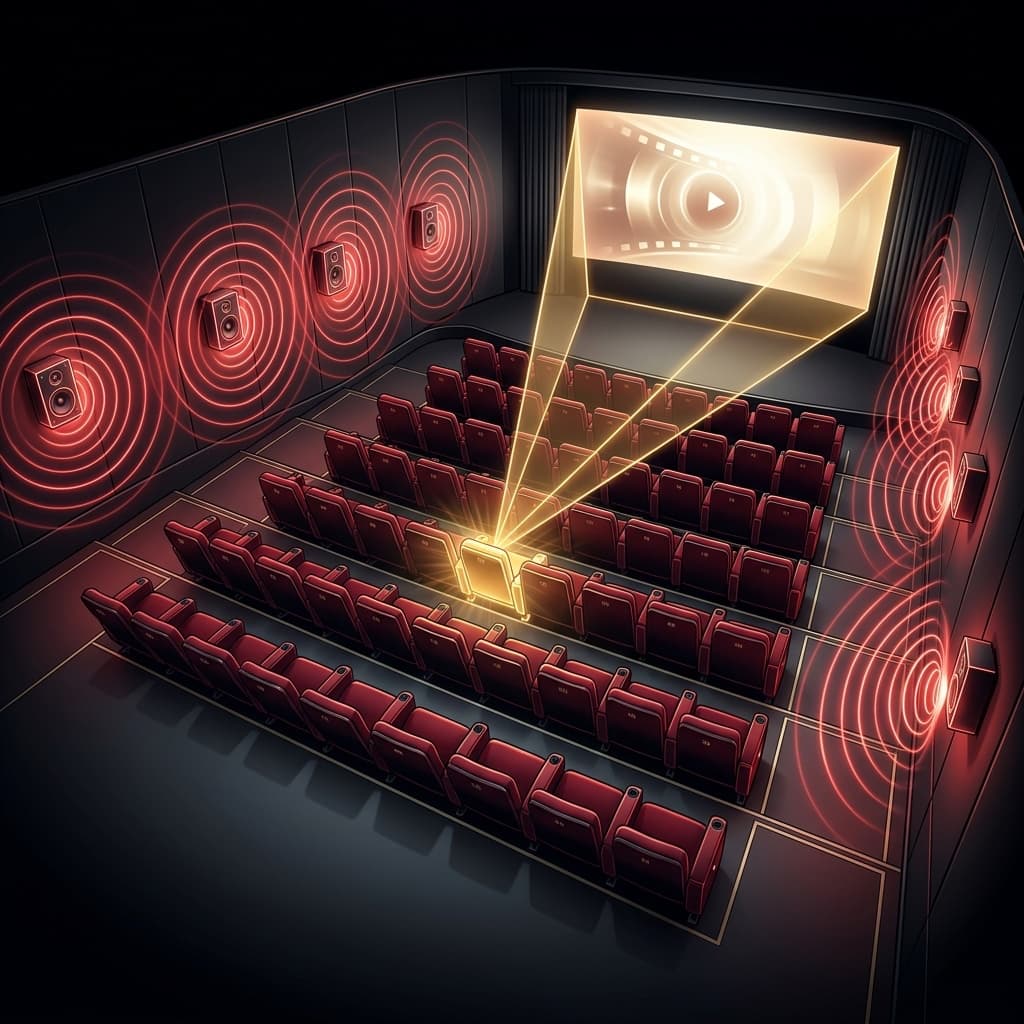
The Universal Best Seat Rule
Across all cinema formats, the consistently best seat is located two-thirds of the way back from the screen, centred on the middle column. This position is sometimes called the “director's seat” because it is where filmmakers sit to review their work during colour-grading and sound-mixing sessions.
At this distance, the screen fills roughly 40–55 degrees of your horizontal field of view — wide enough to be immersive without requiring you to move your head to follow the action. The surround speakers are balanced around you, and the subtitled text (if present) is at a comfortable reading angle.
How Screen Size Changes the Best Seat
The optimal viewing distance is proportional to the screen width. A widely accepted guideline is to sit at 1.5 to 2 times the screen width away from the screen. This ensures the picture fills enough of your vision for immersion without causing eye strain.
- Standard (14m screen): Sit 21–28m back → rows 6–8 in a typical hall
- IMAX (22m+ screen): Sit 33–44m back → rows 8–11
- Dolby Cinema (16m screen): Sit 24–32m back → rows 5–7
The Three Factors of Seat Quality
1. Viewing Angle
Measured in degrees, viewing angle describes how much of your field of vision the screen occupies. THX recommends at least 36 degrees; IMAX aims for 70+. CinemaView calculates this for every seat. Learn more about viewing angles →
2. Audio Coverage
Surround sound is designed for the centre of the hall. Side and back seats hear directional effects at skewed angles. Object-based systems like Dolby Atmos are especially sensitive to seating position. You can read more about cinema speaker configurations on THX Standards.
3. Immersion
A composite of viewing angle, audio balance, and screen coverage. CinemaView's scoring engine combines all three into a single quality score for every seat. The Best Seat button jumps you to the highest-scored position automatically.
Best Seat by Format
- Best seat in IMAX — Upper-middle section, rows 8–11 centre
- Best seat in Dolby Cinema — Dead centre, rows E–G
- Best seat in ScreenX — Centre-middle, rows 5–8
- Best seat in 4DX — Centre-middle, rows 5–8
Common Seat Selection Mistakes
- Booking the back row for “comfort”: The screen shrinks to a small rectangle. You lose all immersion.
- Choosing aisle seats for convenience: Side seats distort geometry and unbalance surround sound.
- Front row for “closeness”: The screen extends beyond your field of view. Neck strain sets in after 20 minutes.
Preview Before You Book
Stop guessing and start previewing. CinemaView lets you see the screen from any seat across all major cinema formats — free, in your browser, before you spend money on tickets. Read our movie screen size guide to understand how screen dimensions affect your experience.