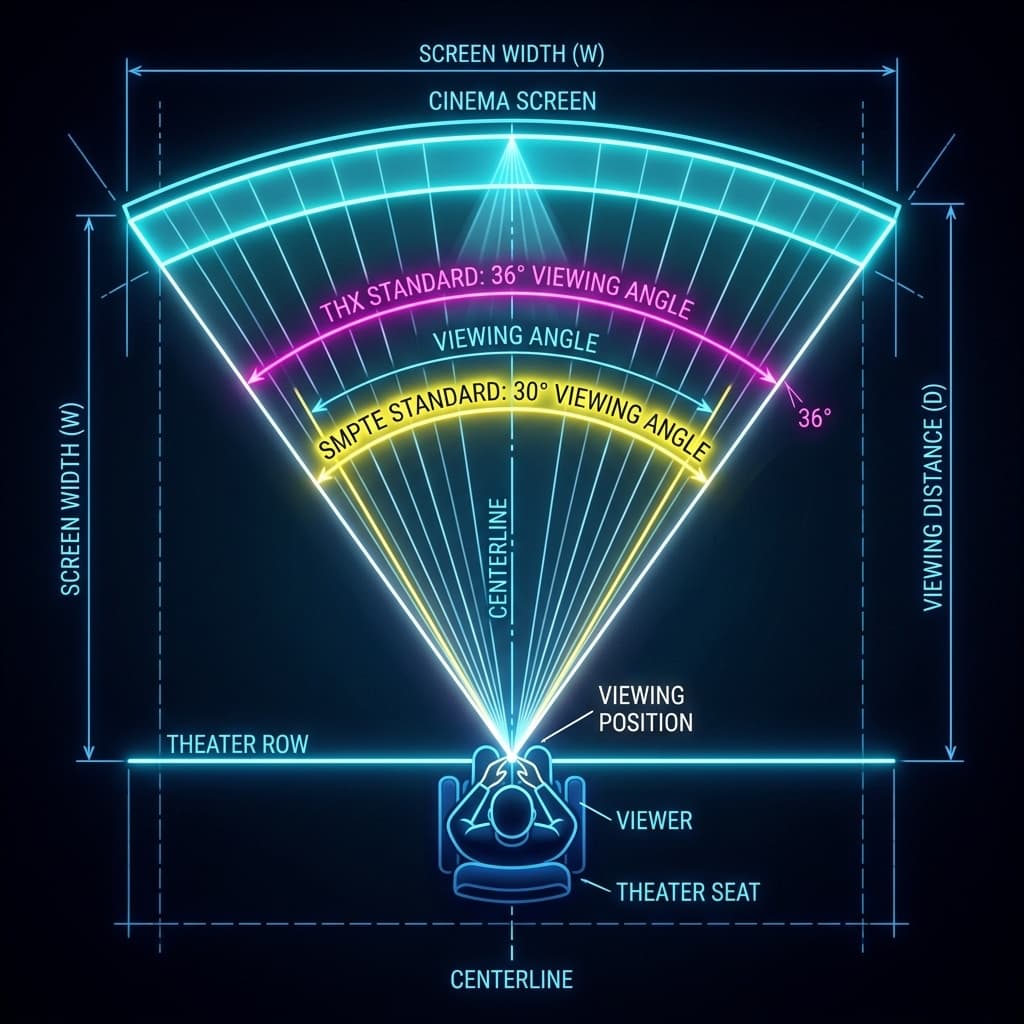
What Is Cinema Viewing Angle?
Viewing angle measures how many degrees of your horizontal field of vision the cinema screen occupies. A wider angle means the picture fills more of your vision, creating a stronger sense of immersion. Too narrow and it feels like watching a TV; too wide and you cannot see the edges without turning your head. Learn about screen dimensions in our Movie Screen Size Guide.
THX Recommended Viewing Angles
THX, the cinema quality certification company founded by George Lucas, recommends specific viewing angles for different experiences:
- Minimum acceptable:26 degrees — below this, the cinema experience feels “flat”
- Recommended minimum: 36 degrees — the threshold for a satisfying cinema experience. Find official standards on the THX Website.
- Optimal: 54 degrees — the sweet spot where immersion is high without strain
- IMAX target: 70+ degrees — designed to fill your entire forward vision
How Distance Affects Viewing Angle
For a given screen width, your viewing angle is purely determined by your distance from the screen. The relationship follows basic trigonometry: closer means a wider angle, further means narrower.
The practical guideline is to sit at 1.5 to 2 times the screen width:
- At 1× screen width: ~53° viewing angle — immersive but requires eye movement to track edges
- At 1.5× screen width: ~37° — the THX recommended sweet spot. Read more in our Best Cinema Seating Guide.
- At 2× screen width: ~28° — comfortable but less immersive
- At 3× screen width: ~19° — too far; feels like a large TV
Vertical Viewing Angle
Horizontal angle gets the most attention, but vertical angle matters too. If the top of the screen requires you to tilt your head more than 15 degrees upward, neck strain will set in during a feature-length film. This is the main reason front-row seats are uncomfortable — the vertical angle to the top of the screen can exceed 40 degrees.
Off-Centre Angle
Sitting off-centre introduces asymmetry in your viewing angle. The near edge of the screen appears wider while the far edge appears narrower. This creates a trapezoidal distortion of the picture — more noticeable on flat screens (Dolby Cinema) than curved screens (IMAX).
CinemaView calculates the off-centre penalty and factors it into the seat quality score. Centre seats always score higher than edge seats at the same distance from the screen.
Viewing Angle by Cinema Format
- IMAX: 60–80° from the best seat. Screen designed to fill peripheral vision. Read more in our Ultimate IMAX Guide.
- Dolby Cinema: 40–55° from the best seat. Optimised for contrast and audio precision. Compare them in our IMAX vs Dolby Cinema Guide.
- ScreenX: 270° with side panels active. The main screen angle follows standard cinema norms.
- Standard Cinema: 35–50° from the best seat.
Measure Your Viewing Angle with CinemaView
CinemaView calculates the exact viewing angle for every seat in every format. Select a seat and the HUD displays your horizontal screen coverage, distance, and quality score. Compare formats side by side to understand how screen size directly affects your immersion.